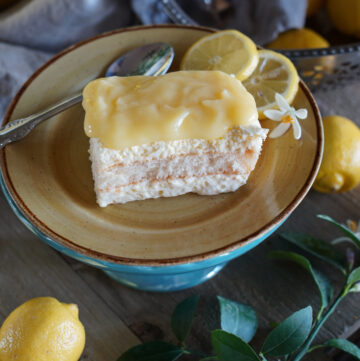
Lemon Tiramisu with Easy Lemon Curd
A bright, citrusy lemon tiramisu made with easy microwave lemon curd!
Equipment
- Microwave
- Stand Mixer or Hand Mixer
- Rectangular Baking Dish 9" x 13" x 2"D
Ingredients
Easy Lemon Curd
- 1 Cup Freshly squeezed lemon juice about 5 1/2 to 6 lemons
- 8 Tbsp Unsalted Butter
- 1 Heaping Cup White Granulated Sugar about 254 grams
- 3 Large Whole Eggs room temperature
- 1 Large Egg Yolk room temperature
Lemon Simple Syrup
- 1 1/3 Cup White Granulated Sugar
- 1/2 Cup Freshly squeezed lemon juice
- 1/2 Cup Water
Mascarpone Cream
- 4 Large Eggs Separated room temperature
- 4 Heaping Tablespoons White Granulated Sugar 65 grams
- 16 Oz. Mascarpone room temperature
- 14 Lady Fingers
Instructions
Easy Lemon Curd
- In a microwave-safe bowl, melt the butter in 15- to 20-second bursts until melted. Set aside to cool slightly.
- In a separate microwave-safe bowl, whisk together the eggs, egg yolk, and sugar until smooth. Squeeze fresh lemon juice into a separate measuring cup. Strain juice to remove pulp. Slowly add strained lemon juice to the egg and sugar mixture and whisk until combined.
- Gradually whisk the melted butter into the lemon mixture to ensure everything combines smoothly.
- Microwave the mixture on 50% power starting at 1-minute intervals, whisking well after each burst. (It is important to lower the microwave power to 50%. Cooking the curd on high heat will cause it to curdle.) Continue microwaving and whisking until the curd starts to thicken. Once it starts thickening a bit, decrease time intervals to 30 seconds. Curd is finished once it's thick enough to coat the back of a spoon—this usually takes 6 to 7 minutes total, depending on your microwave. The curd should be thick but still pourable. If it’s too thin, microwave for 15–30 seconds more, whisking in between. Keep in mind that it will thicken further as it cools.
- For an ultra-smooth curd, strain it through a fine-mesh sieve to remove any bits of cooked egg or pulp. Transfer to a clean jar or container and let cool to room temperature before refrigerating.
Lemon Simple Syrup
- Start by combining the water and sugar in a small saucepan. Place the saucepan over medium heat and stir until the sugar has completely dissolved into the water. This will only take a couple of minutes, so keep an eye on it.
- Remove the syrup from the heat and stir in the fresh lemon juice. The lemon juice gives the syrup that lovely tart edge, balancing out the sweetness.
- Allow the lemon simple syrup to cool completely before using it. Store in an airtight container in the refrigerator for up to 1 week. Any leftover syrup can be used to make a delicious lemonade!
Mascarpone Cream
- Carefully separate the eggs, ensuring that not even the tiniest bit of yolk gets into the whites. This will allow you to whip the egg whites to stiff peaks, adding volume and lightness to your mascarpone mixture.
- In a large bowl, whisking by hand or using a hand blender, beat the egg yolks and sugar together until the mixture becomes pale, thick, and creamy. This process will take about 3-5 minutes of whisking by hand or 2-3 minutes with an electric mixer.
- Once the egg and sugar mixture has reached a thick, creamy consistency, beat in the mascarpone cheese. Mix until smooth and velvety. Avoid overmixing, as you want to preserve the light texture of the mascarpone.
- Using a stand mixer or the cleaned beaters of the hand blender, whip the egg whites into stiff peaks. You should be able to turn the bowl upside down and the egg whites not budge.
- Carefully and gently fold the whipped egg whites into the mascarpone mixture until incorporated. The finished mixture should be light and airy.
Assembly:
- Spread half of the mascarpone mixture in the bottom of your dish.
- In a separate shallow dish, pour the cooled lemon syrup. Quickly dip the ladyfingers into the syrup, one at a time, ensuring they are soaked but not soggy.
- Lay the soaked ladyfingers on top of the mascarpone mixture, arranging them in a neat layer. Then, spread the remaining mascarpone mixture over the ladyfingers. Smooth it out gently to cover evenly.
- Finish by spreading the cooled lemon curd on top.
- Cover with plastic wrap making sure the wrap does not come into contact with the curd. Refrigerate overnight.
Video
Notes
- While the microwave lemon curd is easy and fast to make, jarred lemon curd is absolutely an acceptable substitute!
- Make sure that beaters used for the egg whites are completely clean. Any amount of egg yolk and/or grease on beaters or bowl will result in egg whites not being able to form or stiffen.
- This recipe can also be made into individual tiramisus. I love to use pretty glass goblets for individual ones.